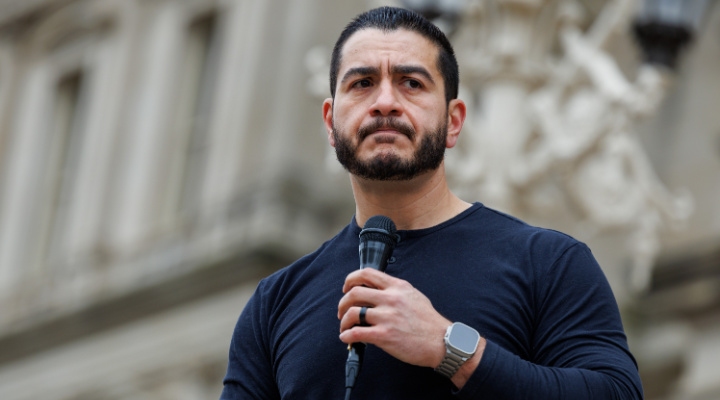
RNC Research put it bluntly this week: Abdul El-Sayed is a liar.
The Michigan Democrat running for the U.S. Senate spent years telling audiences that Medicare for All would “do away with the private insurance market” and leave “one insurance program for everyone.” Then he sat down with Ezra Klein for a New York Times Opinion interview and tried a softer pitch.
Watch the clip. El-Sayed compares his plan to public schools. You pay taxes whether you use the system or not. The government guarantee is always there. If you want a private option “above that,” he says, “you’re welcome to do that.” Then comes the tell: “Our goal is to build a floor so high that most folks would be like, why would I?”
That is not a defense of choice. That is a plan to crowd private coverage out of existence and call the wreckage “optional.”
The Record He Wants You to Forget
El-Sayed did not invent this overnight. He co-authored a book on Medicare for All. He ran for Michigan governor in 2018 attacking private insurers. In 2019 he said anything that still required private coverage for part of the population “is not real Medicare for All.” A 2020 podcast clip has him stating the program “does away with the private insurance market.” Republicans have compiled at least ten instances of the same message.
Now the general election is weeks away. Michigan is a purple state that twice backed Donald Trump. Union households worry about the coverage they already bargained for. So the language changed. “Not necessarily” the end of private insurance, he told one reporter. A “floor,” not a ceiling, he told Klein. The product is the same. The wrapping is new.
Working families know the difference. When government becomes the dominant payer, private plans do not survive as a real alternative. They become a luxury tax on people already forced to fund the public system. That is how single-payer systems work in practice. Wait lists grow. Innovation slows. Bureaucrats decide what is “necessary.” The patient who wants a second opinion, a faster specialist, or a doctor who still works for the patient instead of the agency is told to wait his turn.
What “Everyone Pays In” Really Means
El-Sayed has already conceded the tax piece. Asked whether people earning under a million dollars would see higher taxes, he answered that Americans would simply “pay for health care in a different way.” That is the old Obamacare promise in a new lab coat: keep your coverage, except now the IRS collects the premium and it may go up.
Experts who have run the numbers say middle-class tax hikes are the likely result, even if some lower-income households come out ahead on paper. Seniors already on Medicare would be asked to share a system suddenly flooded with every working-age American. Rural hospitals that depend on private reimbursement would face the same rate cuts that close wards in other single-payer countries.
This is not compassion. It is central planning dressed up as a public school metaphor. Public education is a local, state-centered institution with real parental exit ramps—private schools, charters, homeschooling. El-Sayed’s healthcare “floor” is a national monopoly with one payer and one set of rules written in Washington. Families who want to keep the doctor they trust, the plan their union won, or a policy that does not fund procedures that violate their faith would be paying twice for the privilege.
America’s healthcare system is expensive and frustrating. Conservatives should say that out loud. The answer is not to hand the entire market to the same federal apparatus that cannot keep the southern border closed or the VA wait times honest. Competition, price transparency, association plans, and letting people keep what works have a better record than slogans about “cradle to grave” coverage from politicians who have never had to live under the systems they praise.
El-Sayed is the Democratic nominee in a race that will help decide control of the Senate. His opponent, former Rep. Mike Rogers, has made the tax-and-ban record a central argument. Polls show a tight contest. That is exactly why the language shifted.
Voters should listen to what he said when he thought the primary audience was the left, not what he says now that independents are watching. A candidate who spent a decade promising to eliminate private insurance does not suddenly become a champion of choice because he added the words “you’re welcome to” in a New York Times studio.
America remains the last, best hope for a system that treats patients as citizens, not wards. That system requires the freedom to buy coverage the government did not design. El-Sayed’s “high floor” is a ceiling with better branding. Conservatives should treat it that way.
About the Author