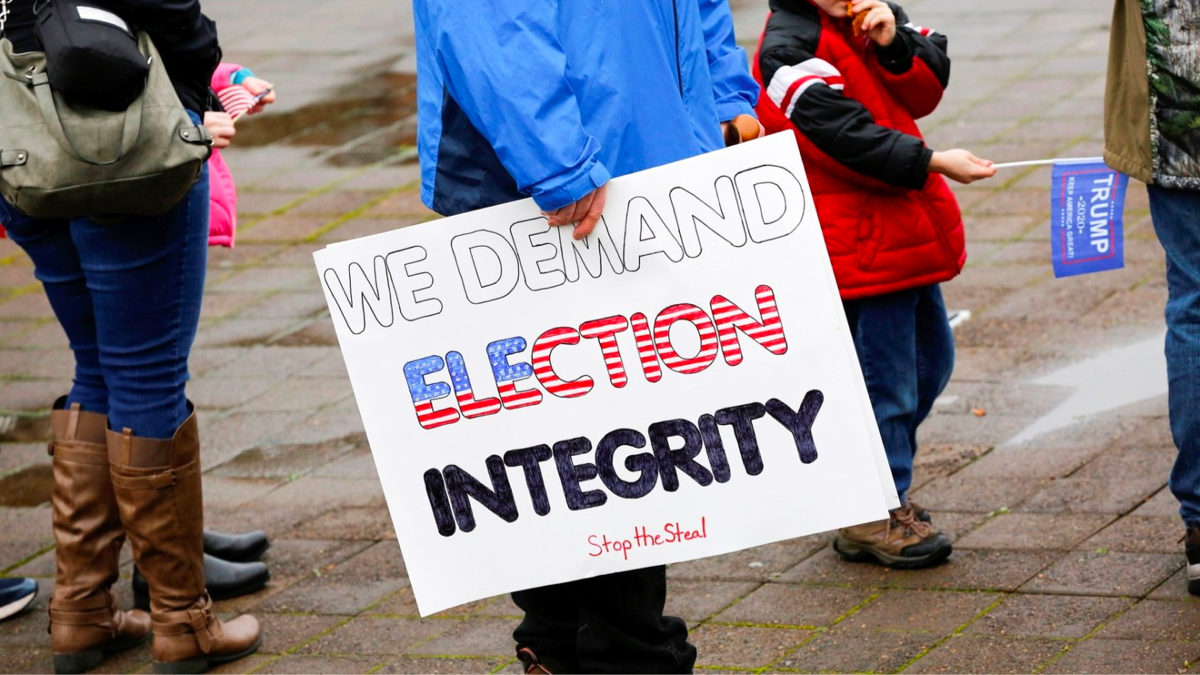

House Republicans are once again pushing for common-sense voter reforms—voter identification requirements, limits on mass mail-in voting, and safeguards around same-day voting. These proposals are routinely framed by Democrats and progressive activists as attempts at “voter suppression,” with some going so far as to label them “Jim Crow 2.0.” That accusation is not only historically dishonest, it distracts from the real issue at hand: protecting the integrity of the American vote.
Ironically, it was the Democratic Party during Reconstruction and well into the early twentieth century that authored and enforced Jim Crow laws—policies explicitly designed to prevent Black Americans and women from voting. Poll taxes, literacy tests, and intimidation were the tools of suppression then. Today, requiring a photo ID to vote—something required to board a plane, open a bank account, or pick up a prescription—is falsely portrayed as oppression. The comparison collapses under even modest historical scrutiny.

America is the greatest social experiment in human history—a nation founded not on bloodline or monarchy, but on shared ideals. Central among those ideals is civic participation, with voting at its core. The right to vote is sacred. It must be encouraged, protected, and exercised freely by every eligible citizen. But a right that is not safeguarded is easily abused. And when elections are vulnerable, power attracts those willing to cheat to obtain it.
The Founding Fathers understood this clearly. They did not assume that virtue alone would protect the Republic. James Madison warned that men are not angels, and that government must be designed with safeguards because ambition and self-interest are constants of human nature. Free elections were essential—but only if conducted honestly and lawfully.

George Washington, in his Farewell Address, cautioned that the Constitution and laws must be preserved with vigilance, warning that the spirit of encroachment tends to consolidate power through subtle means rather than sudden force. Election manipulation—whether through lax standards, administrative overreach, or deliberate fraud—is precisely the kind of quiet erosion Washington feared.
Thomas Jefferson repeatedly emphasized that the legitimacy of a republic rests on the consent of the governed. But consent loses its meaning when ballots are diluted, mishandled, or cast unlawfully. A system that cannot reliably determine who is voting, how many times they vote, or whether they are even eligible undermines public trust. And without trust, the Republic falters.
Over the past decade, Americans have witnessed growing concerns about election practices. Ballot harvesting operations—often organized and funded—have proliferated in states with weak safeguards. Allegations of individuals voting twice, non-citizens participating in elections, and local officials unilaterally altering election rules outside of legislative authority have become disturbingly common. Even when fraud is difficult to quantify, the appearance of vulnerability alone is damaging. Confidence in elections is not optional—it is foundational.

Abraham Lincoln famously described our system as “government of the people, by the people, for the people.” That promise depends entirely on the integrity of “the people’s” voice. When lawful votes are canceled out by unlawful ones, the people are no longer governing themselves. They are being governed by chaos—or worse, manipulation.
In my view, the solution is neither radical nor partisan. Only verifiable American citizens should be allowed to vote in American elections—local, state, or federal. Voter identification should be the law of the land, uniform and enforced nationwide. This is not suppression; it is stewardship. A nation that fails to protect its elections cannot long protect its freedoms.

Moreover, the law must have teeth. Those who knowingly violate election laws—whether by voting illegally, facilitating fraud, or subverting safeguards—should face serious consequences. The rule of law demands nothing less. A system that tolerates lawbreaking invites more of it.
John Adams once warned that our Constitution was made for a moral and religious people and is wholly inadequate for any other. That moral framework includes honesty, accountability, and respect for the law. Election integrity is not merely a political issue—it is a moral one.
We should encourage every eligible American to vote. We should make the process accessible, transparent, and fair. But accessibility without accountability is not justice—it is negligence. Protecting the vote protects the voice of the citizen, the legitimacy of our leaders, and the future of the Republic itself.
In the end, this is not about Left versus Right. It is about right versus wrong. A free people deserve free and fair elections—and it is our duty to ensure they remain exactly that.
About the Author